Pythagorean vs Chaldean Numerology: What’s the Difference?
If you’ve calculated your name number using two different online calculators and gotten two different results, you’re not imagining things. The most likely reason is that one calculator used the Pythagorean system and the other used Chaldean numerology — two distinct traditions that assign different numbers to the same letters.
Both systems claim to reveal meaning through your name, but they go about it in very different ways. This guide breaks down exactly how each one works, where they diverge, and how to decide which one to use.
Two Numerology Systems, One Goal
Both Pythagorean and Chaldean numerology start from the same basic idea: letters carry numeric — and therefore symbolic — value. Add up the numbers in a name, and you get insight into personality, tendencies, and life direction.
Where they differ is in how letters get their numbers, which numbers are used, and how old each tradition is.
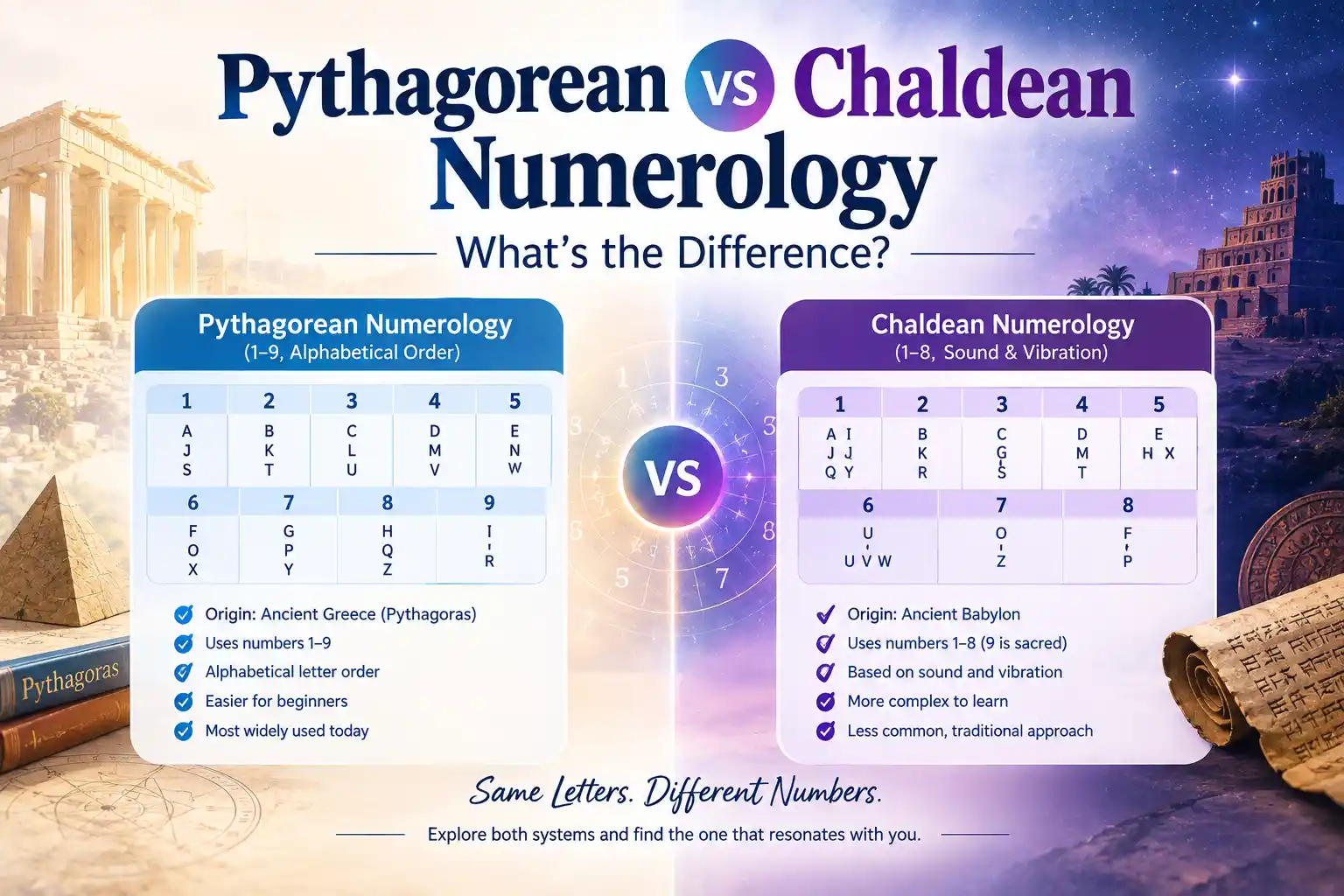
| Aspect | Pythagorean Numerology | Chaldean Numerology |
|---|---|---|
| Origin | Ancient Greece, linked to Pythagoras | Ancient Babylon (Mesopotamia) |
| Letter assignment | Sequential, A–Z in alphabetical order | Based on sound/vibration, not alphabetical order |
| Numbers used | 1 through 9 | 1 through 8 (9 is considered sacred and excluded) |
| Popularity today | Most widely used in Western numerology | Less common, considered more traditional/mystical by some practitioners |
| Calculation basis | Full birth name, straightforward | Often based on the name a person currently uses or is known by |
| Complexity for beginners | Simpler, easier to learn | Slightly more complex, less intuitive letter groupings |
Neither system is universally recognized as “more accurate” than the other — they’re different traditions with different historical roots, and the choice between them largely comes down to which framework you trust or prefer.
[INTERNAL LINK OPPORTUNITY: How to calculate your name number]
Pythagorean Numerology Explained
Origins
Pythagorean numerology is attributed to Pythagoras, the ancient Greek philosopher and mathematician, who believed numbers held vibrational and symbolic significance beyond their mathematical function. This system became the foundation for most modern Western numerology practices.
The Pythagorean Chart
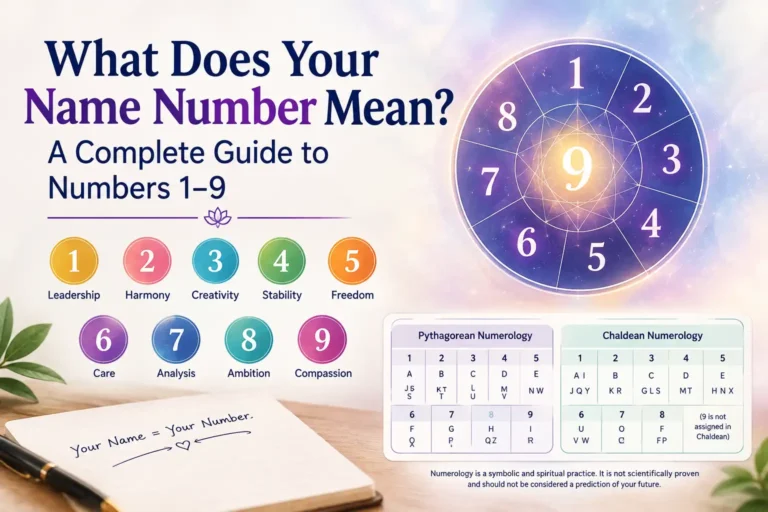
Letters are assigned numbers 1 through 9 in a simple, repeating alphabetical sequence:
| Number | Letters |
|---|---|
| 1 | A, J, S |
| 2 | B, K, T |
| 3 | C, L, U |
| 4 | D, M, V |
| 5 | E, N, W |
| 6 | F, O, X |
| 7 | G, P, Y |
| 8 | H, Q, Z |
| 9 | I, R |
This structure is easy to memorize because it simply cycles through the alphabet.
How to Calculate Using the Pythagorean System
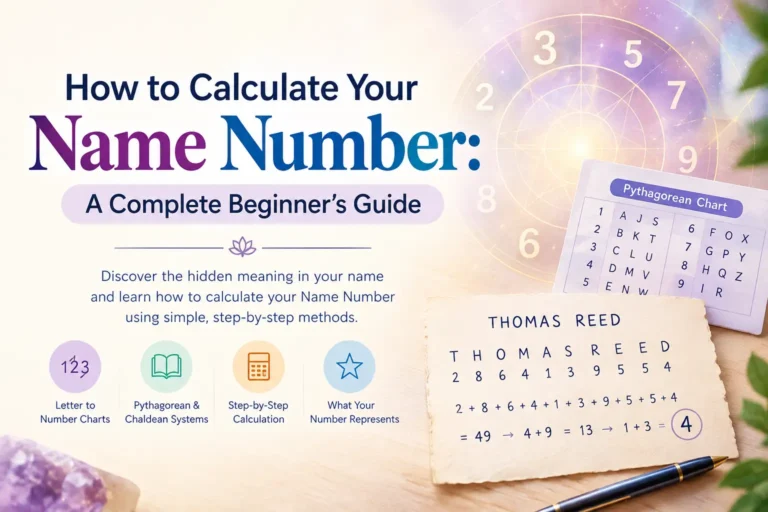
Example name: LAURA SMITH
- Convert each letter to its number:
L-A-U-R-A  =  3-1-3-9-1
S-M-I-T-H = 1-4-9-2-8- Add the numbers:
3+1+3+9+1 = 17
1+4+9+2+8 = 24
17 + 24 = 41- Reduce to a single digit:
41 → 4 + 1 = 5Laura’s Pythagorean name number is 5.
[INTERNAL LINK OPPORTUNITY: Complete guide to calculating your name number]
Chaldean Numerology Explained
Origins
Chaldean numerology is considered one of the oldest numerology systems, originating in ancient Babylon. Rather than assigning numbers alphabetically, it groups letters by their sound and vibrational quality — a method many practitioners consider more intuitive to the letter’s true energetic value, though this is a matter of tradition and belief rather than something verifiable.
The Chaldean Chart
Chaldean numerology uses only the numbers 1 through 8. The number 9 is left out of standard calculations because it’s considered sacred, representing completeness or divinity.
| Number | Letters |
|---|---|
| 1 | A, I, J, Q, Y |
| 2 | B, K, R |
| 3 | C, G, L, S |
| 4 | D, M, T |
| 5 | E, H, N, X |
| 6 | U, V, W |
| 7 | O, Z |
| 8 | F, P |
Notice that the letters aren’t in alphabetical order within each number group — this non-sequential structure is what beginners often find harder to memorize compared to the Pythagorean chart.
How to Calculate Using the Chaldean System
Same example name: LAURA SMITH
- Convert each letter using the Chaldean chart:
L-A-U-R-A  =  3-1-6-2-1
S-M-I-T-H = 3-4-1-4-5- Add the numbers:
3+1+6+2+1 = 13
3+4+1+4+5 = 17
13 + 17 = 30- Reduce to a single digit:
30 → 3 + 0 = 3Laura’s Chaldean name number is 3 — a completely different result from the Pythagorean number 5, calculated from the exact same name.
This side-by-side comparison shows exactly why the same person can get two different “name numbers” depending on which system a calculator uses.
Why the Numbers Come Out Differently
The core reason Pythagorean and Chaldean numerology produce different results is structural:
- Different letter-to-number logic. Pythagorean follows the alphabet in order. Chaldean groups letters by sound and vibration, so the same letter can land on a completely different number between systems (for example, “A” is 1 in both, but “S” is 1 in Pythagorean and 3 in Chaldean).
- Different number range. Pythagorean uses 1–9. Chaldean uses only 1–8, treating 9 as sacred and excluding it from regular letter assignments.
- Different philosophical basis. Pythagorean numerology is rooted in mathematical order; Chaldean numerology is rooted in sound and vibration, reflecting older mystical traditions.
Because of these structural differences, you should never mix the two charts in a single calculation — doing so produces numbers that don’t correspond to either system and are essentially meaningless within either tradition.
Master Numbers: 11, 22, and 33
Both Pythagorean and Chaldean numerology recognize Master Numbers, though they’re most commonly discussed in Pythagorean practice.
Master Numbers are not reduced further once you reach them in a calculation. They’re treated as holding amplified, more intense energy compared to their reduced counterparts:
| Master Number | Reduces From | Root Number | Traditional Theme |
|---|---|---|---|
| 11 | — | 2 | Heightened intuition, sensitivity |
| 22 | — | 4 | Large-scale building, practical vision |
| 33 | — | 6 | Deep compassion, guidance |
Example: If your total before final reduction is 29, you’d normally reduce it as 2+9=11. Since 11 is a Master Number, you stop there — you do not reduce it further to 1+1=2.
This rule applies whether you’re using the Pythagorean or Chaldean chart, since it relates to the final total of a calculation rather than the letter-assignment method itself.
[INTERNAL LINK OPPORTUNITY: Understanding Master Numbers in numerology]
Which System Should You Use?
There’s no single correct answer — the right system depends on your goals and preferences.
Choose Pythagorean numerology if:
- You’re a beginner looking for a simpler, more intuitive system
- You want the most widely available calculators, guides, and interpretations
- You prefer a system rooted in straightforward alphabetical logic
Choose Chaldean numerology if:
- You’re drawn to older, more traditional mystical practices
- You want to explore a system some practitioners consider closer to a letter’s “true” vibrational value
- You’re comparing results across systems for a more complete symbolic picture
Some numerologists calculate both and compare the results, treating each system as offering a different lens rather than competing for a single “correct” answer.
Common Mistakes to Avoid
- Mixing the two charts mid-calculation. Using some Pythagorean values and some Chaldean values in the same calculation produces meaningless results.
- Assuming one system is scientifically more accurate. Neither system has scientific backing; the difference is philosophical and historical, not empirical.
- Forgetting that Chaldean excludes 9 from letters. Beginners sometimes try to fit letters into a 1–9 range when using the Chaldean chart, which is incorrect — 9 is reserved and not assigned to any letter.
- Reducing past a Master Number. In both systems, if your final total lands exactly on 11, 22, or 33, stop reducing.
- Not being consistent across readings. If you calculate your Expression Number using Pythagorean numerology one time, use the same system for related readings (like your Life Path or Soul Urge Number) to keep results comparable.
Pythagorean vs Chaldean: Quick Comparison Table
| Feature | Pythagorean | Chaldean |
|---|---|---|
| Age | Younger (ancient Greece) | Older (ancient Babylon) |
| Letter logic | Alphabetical sequence | Sound-based grouping |
| Number range | 1–9 | 1–8 |
| Ease for beginners | Easier | More complex |
| Common use today | Most Western numerology sites and books | Niche, favored by traditionalists |
| Name typically used | Full birth name | Often the name a person commonly uses |
[INTERNAL LINK OPPORTUNITY: Life Path Number calculator and guide]
Is Either System Scientifically Proven?
No. Both Pythagorean and Chaldean numerology are symbolic and spiritual traditions passed down through history, not systems supported by scientific research. There’s no peer-reviewed evidence that either method of converting letters into numbers can predict personality traits or life outcomes.
That doesn’t make the practice without value — many people use numerology, in either form, as a structured way to reflect on their identity and choices, similar to how they might engage with astrology or personality frameworks. The insight comes from the reflection the process prompts, not from any measurable predictive power in the numbers themselves.
Frequently Asked Questions
What’s the main difference between Pythagorean and Chaldean numerology?
Pythagorean numerology assigns numbers 1–9 to letters in straightforward alphabetical order, while Chaldean numerology assigns numbers 1–8 based on sound and vibration, excluding 9 as a sacred number.
Which numerology system is more accurate?
Neither is scientifically more accurate than the other, since numerology itself isn’t backed by scientific evidence. The choice comes down to tradition, personal preference, and which system’s framework resonates with you.
Can I get different name numbers from each system?
Yes. Because the two systems assign different numeric values to the same letters, calculating the same name in both systems will often produce different results.
Which system is older, Pythagorean or Chaldean?
Chaldean numerology is generally considered older, tracing back to ancient Babylon, while Pythagorean numerology developed later in ancient Greece.
Why does Chaldean numerology skip the number 9?
In Chaldean tradition, 9 is considered a sacred or divine number and is intentionally left out of standard letter-to-number assignments.
Can I mix Pythagorean and Chaldean numbers in one calculation?
No. Mixing charts produces numbers that don’t align with either system’s logic and won’t correspond to accurate interpretations in either tradition.
Do Master Numbers work the same way in both systems?
Yes. In both Pythagorean and Chaldean numerology, if a final calculation lands exactly on 11, 22, or 33, that number is kept as-is rather than reduced further.
Which system should beginners start with?
Most beginners find Pythagorean numerology easier to learn because of its simple, alphabetical letter-to-number structure. Chaldean numerology can be explored afterward for a deeper or comparative perspective.
Final Thoughts
Pythagorean and Chaldean numerology are two distinct paths to the same destination: using your name to explore symbolic insight into your personality and life direction. Pythagorean numerology offers a simpler, more accessible entry point, while Chaldean numerology carries an older, more intricate tradition rooted in sound and vibration.
Neither is scientifically validated, and neither is “more correct” than the other — they’re different lenses for the same kind of self-reflection. Whether you stick to one system or explore both, the real value lies in what the process encourages you to think about, not in treating the numbers as fact.