How to Calculate Your Name Number: A Complete Beginner’s Guide
Every name carries letters, and every letter carries a number. That’s the entire premise behind one of numerology’s most popular starting points — the Name Number. If you’ve ever wondered whether there’s meaning hiding in the way your name is spelled, this guide will walk you through exactly how to find out, using a method anyone can follow with just a pen and paper.
By the end, you’ll know how to calculate your Name Number correctly, what it traditionally represents, how Master Numbers fit in, and where Pythagorean and Chaldean numerology differ.
What Is a Name Number?
A Name Number is a single digit — or occasionally a Master Number (11, 22, or 33) — calculated by converting each letter in a name into its corresponding number and adding them together until you reach a final result.
This idea comes from numerology, a symbolic practice that treats numbers as carriers of meaning. In numerology, your name isn’t just a label; it’s viewed as a code that reflects personality traits, tendencies, and life direction.
Depending on the source, “Name Number” is used in slightly different ways:
- Some treat it as identical to the Expression Number (also called the Destiny Number), calculated from your full birth name.
- Others use it more casually to describe a quick calculation from just a first name or commonly used name.
There’s no single global authority standardizing the term, so this guide covers the traditional full-name method, since it’s the most widely taught and the most complete.
[INTERNAL LINK OPPORTUNITY: Expression Number explained]
Where Name Numerology Comes From
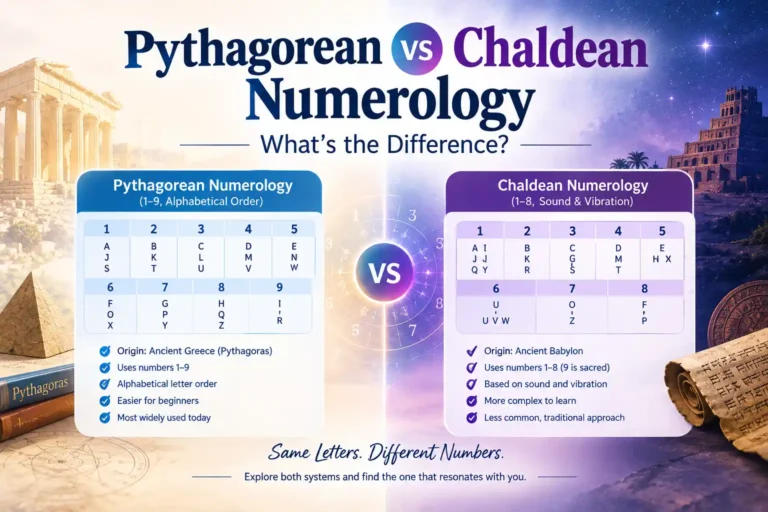
Name numerology has two major traditions, and understanding both helps explain why you might see different numbers depending on which calculator or article you use.
| System | Origin | Letter Assignment | Common Use Today |
|---|---|---|---|
| Pythagorean | Ancient Greece, linked to Pythagoras | A–Z assigned 1–9 in sequential order | Most widely used in Western numerology |
| Chaldean | Ancient Babylon/Mesopotamia | Letters grouped by sound/vibration, numbers 1–8 used (9 reserved as sacred) | Older system, considered by some practitioners to be more traditional |
Both are treated as symbolic frameworks passed down through tradition — not systems verified by scientific research. This guide will primarily use the Pythagorean method since it’s simpler for beginners, but the Chaldean chart is included below for comparison.
The Pythagorean Letter-to-Number Chart
In the Pythagorean system, letters repeat through the numbers 1 to 9 in alphabetical order:
| Number | Letters |
|---|---|
| 1 | A, J, S |
| 2 | B, K, T |
| 3 | C, L, U |
| 4 | D, M, V |
| 5 | E, N, W |
| 6 | F, O, X |
| 7 | G, P, Y |
| 8 | H, Q, Z |
| 9 | I, R |
[IMAGE OPPORTUNITY: Clean A–Z chart graphic showing each letter’s assigned number]
The Chaldean Letter-to-Number Chart
The Chaldean system uses a different, non-sequential arrangement based on sound values, and it stops at 8 rather than 9:
| Number | Letters |
|---|---|
| 1 | A, I, J, Q, Y |
| 2 | B, K, R |
| 3 | C, G, L, S |
| 4 | D, M, T |
| 5 | E, H, N, X |
| 6 | U, V, W |
| 7 | O, Z |
| 8 | F, P |
Because the two charts assign different values to the same letters, never mix them in one calculation. Pick one system and stay consistent from start to finish.
[INTERNAL LINK OPPORTUNITY: Pythagorean vs Chaldean numerology compared]
How to Calculate Your Name Number: Step-by-Step
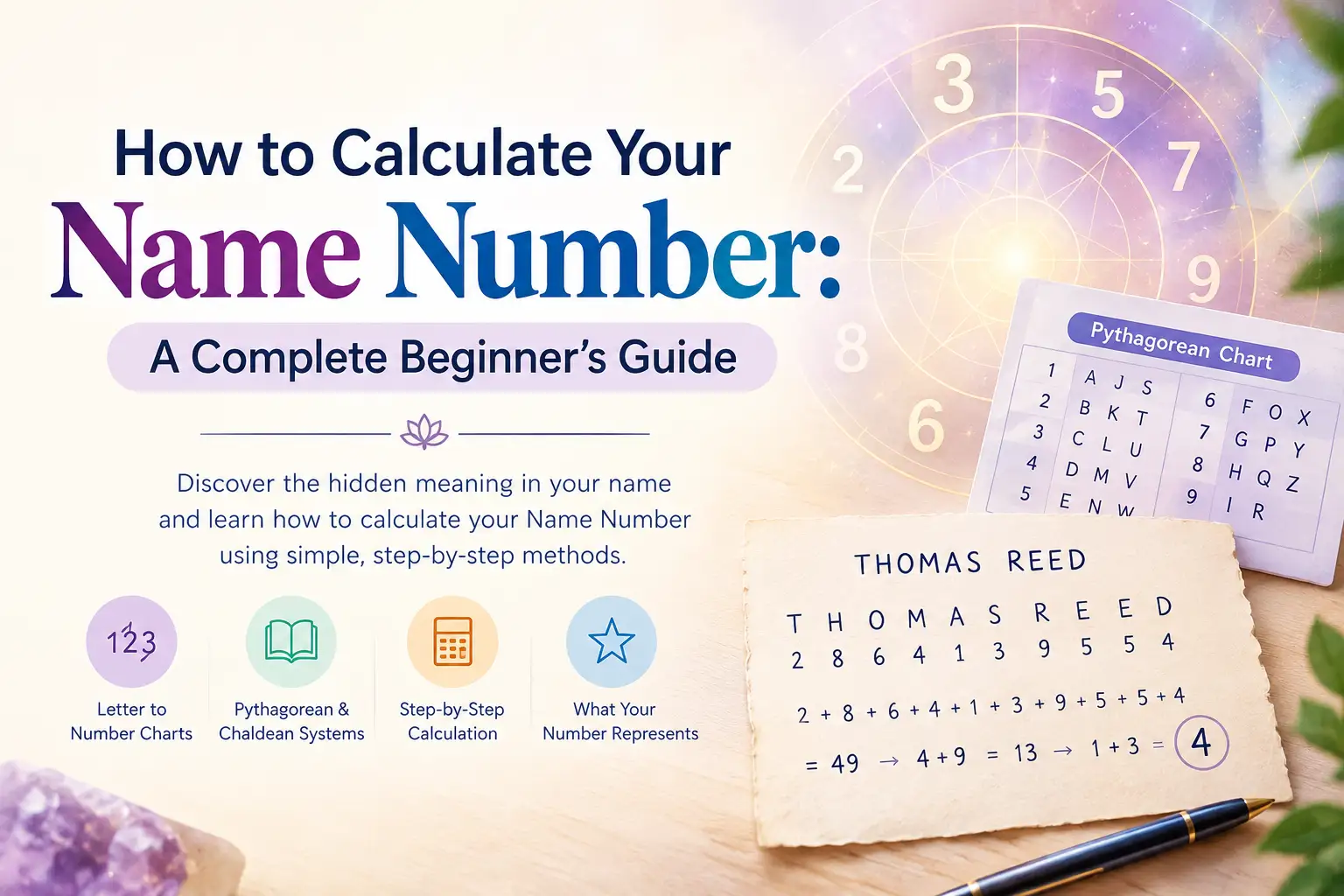
Let’s calculate a Name Number together using the example name THOMAS REED.
Step 1: Choose Which Name You’re Calculating
Decide upfront:
- Full birth name — the traditional approach, used for the Expression Number
- First name only — a quicker, informal version some people use for a general snapshot
Consistency matters more than which option you pick. This walkthrough uses the full name.
Step 2: Convert Each Letter Using the Chart
Using the Pythagorean chart:
T-H-O-M-A-S  =  2-8-6-4-1-1
R-E-E-D      =  9-5-5-4
Step 3: Add the Numbers in Each Name
2+8+6+4+1+1 = 22
9+5+5+4     = 23
Step 4: Add the Totals Together
22 + 23 = 45Step 5: Reduce to a Single Digit
45 → 4 + 5 = 9Thomas’s Name Number is 9.
What If the Total Is 11, 22, or 33?
Stop reducing. In the example above, “THOMAS” alone reduced to 22 — a Master Number — but because the calculation continues when combining names, it may or may not remain a Master Number once every letter is combined. Only stop reducing at the very final total. If the full combined total lands exactly on 11, 22, or 33, that becomes your Name Number as-is.
Understanding Master Numbers: 11, 22, and 33
Master Numbers are treated differently from other numbers in numerology. Instead of reducing them to a single digit, tradition holds that they carry a more intense, amplified version of their root number:
| Master Number | Root Number | Traditional Theme |
|---|---|---|
| 11 | 2 | Heightened intuition and sensitivity |
| 22 | 4 | Large-scale building and practical vision |
| 33 | 6 | Deep compassion and guidance toward others |
A common beginner mistake is reducing 11 down to 2, or 29 down to 11 and stopping there by accident. Master Numbers only apply when they appear as your final total — not at every intermediate step.
What Your Name Number Traditionally Means
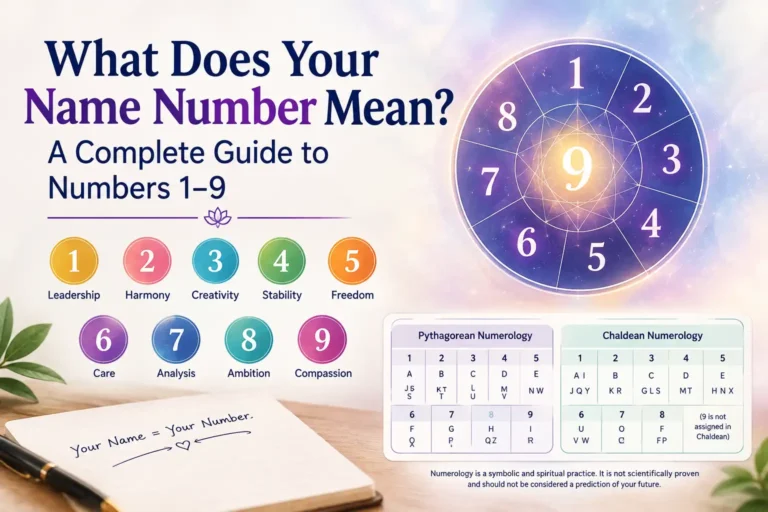
Below is a general overview of the themes numerologists commonly associate with each number. These are symbolic interpretations meant for reflection, not fixed personality descriptions.
| Number | Core Theme | Traditional Strengths | Traditional Watch-Outs |
|---|---|---|---|
| 1 | Independence | Confidence, initiative | Impatience, stubbornness |
| 2 | Partnership | Diplomacy, empathy | Indecisiveness |
| 3 | Expression | Creativity, communication | Scattered focus |
| 4 | Structure | Discipline, reliability | Rigidity |
| 5 | Freedom | Adaptability, curiosity | Restlessness |
| 6 | Responsibility | Nurturing, harmony | Over-giving |
| 7 | Reflection | Insight, analysis | Isolation |
| 8 | Ambition | Drive, authority | Overwork |
| 9 | Compassion | Idealism, generosity | Difficulty setting boundaries |
| 11 | Intuition | Inspiration | Anxiety, overwhelm |
| 22 | Building | Large-scale impact | Pressure to perform |
| 33 | Guidance | Healing, mentorship | Self-sacrifice |
[IMAGE OPPORTUNITY: Number meaning wheel graphic 1–9 plus Master Numbers]
Name Number vs. Expression Number vs. Life Path Number
These three terms get confused often, so here’s a clear breakdown:
| Term | Calculated From | What It Reflects |
|---|---|---|
| Name Number | Letters in a name (full or partial) | General identity tied to your name |
| Expression Number | All letters in your full birth name | Natural talents and life direction |
| Life Path Number | Full birth date | Broader life themes and journey |
In most traditional practice, the Name Number and Expression Number are the same thing when both are calculated using your complete birth name. The term “Name Number” simply becomes more flexible when people use shortened or preferred names instead.
[INTERNAL LINK OPPORTUNITY: How to calculate your Life Path Number]
Special Cases and Exceptions
The Letter Y: Vowel or Consonant?
Y is inconsistent across numerology traditions:
- In most standard Pythagorean charts, Y is treated as a consonant (valued at 7).
- Some numerologists treat Y as a vowel when it produces a vowel sound, such as in “Kyle” or “Amy” — this matters specifically if you’re also calculating a Soul Urge Number, which uses vowels only.
Whichever rule you choose, apply it consistently throughout your calculation.
[INTERNAL LINK OPPORTUNITY: Soul Urge Number and vowel-based calculations]
Repeated Letters
Every letter is counted individually, even when it appears more than once. In “REED,” both E’s are calculated separately (5 + 5), not merged or skipped.
Spaces, Hyphens, and Apostrophes
These carry no numeric value. Skip them entirely and only calculate actual letters — including in hyphenated or multi-part names.
Middle Names
Traditional full-name calculations include every name listed on a birth certificate, including middle names. Skipping them will produce an incomplete result.
Common Mistakes to Avoid
- Mixing Pythagorean and Chaldean charts in a single calculation — the letter values are completely different between systems.
- Reducing a Master Number too far. If your final total is 11, 22, or 33, that’s your stopping point.
- Using a nickname or married name instead of the birth name when the goal is a traditional Expression/Name Number reading.
- Forgetting to include middle names in a full-name calculation.
- Applying an inconsistent Y rule between calculations, leading to mismatched results over time.
- Treating results as guaranteed traits rather than symbolic prompts for self-reflection.
Is Name Numerology Scientifically Proven?
No. Name numerology is a symbolic and spiritual tradition with roots that stretch back thousands of years, but there is no scientific evidence confirming that the letters in a name influence personality, behavior, or life outcomes. It’s best approached the way many people approach astrology or personality frameworks — as a reflective tool, not a predictive or diagnostic one.
That said, the process of calculating and interpreting a Name Number can still be a genuinely useful exercise in self-awareness. Thinking about your traits through the lens of a number can prompt reflection you might not otherwise sit down and do — the value lies in that reflection, not in the number itself holding measurable power.
Quick Reference: Calculate Your Name Number in 5 Steps
- Decide which name you’re using (full birth name is traditional) and stay consistent
- Convert every letter to its number using either the Pythagorean or Chaldean chart — don’t mix them
- Add all letter values together
- Reduce the total to a single digit
- Stop early only if your final total is exactly 11, 22, or 33
[IMAGE OPPORTUNITY: Printable step-by-step worksheet for calculating a name number]
Frequently Asked Questions
What is a Name Number in numerology?
It’s a number — usually a single digit, or occasionally 11, 22, or 33 — derived by converting each letter of a name into a numeric value and adding those values together.
Is the Name Number the same as the Expression Number?
When calculated from a full birth name, yes, they refer to the same result. The term “Name Number” is sometimes used more loosely for shorter or informal calculations.
Should I use my birth name or my current name?
Traditional numerology uses the birth name for the core calculation, since it’s considered the original, unaltered version of your identity. A current or married name can be calculated separately for comparison.
What happens if my name adds up to a Master Number?
If your final total is exactly 11, 22, or 33, you stop reducing — these numbers are kept as-is rather than simplified to a single digit.
Does Y count as a vowel or a consonant?
It depends on the system and the numerologist. Many treat Y as a consonant by default, while others count it as a vowel when it sounds like one. Choose one rule and apply it consistently.
Can I use numerology to calculate a business name?
Yes. The same letter-to-number method applies to business or brand names, and some entrepreneurs use it as one factor among many when choosing a name.
Do Pythagorean and Chaldean systems give the same result?
No. Because the two systems assign different numbers to the same letters, calculating the same name in each system will usually produce different results.
Is a Name Number calculator accurate?
An online calculator can perform the math correctly, but accuracy here refers only to correct arithmetic — not scientific validity, since numerology itself isn’t a verified predictive system.
Final Thoughts
Calculating your Name Number is a simple process once you understand the chart, the steps, and the exceptions to watch for — whether you’re using the Pythagorean or Chaldean method. While it isn’t backed by scientific research, many people find real value in the reflection it encourages: a small, symbolic pause to think about who they are and where their name might point.
If you’d like to go deeper, you can compare your Name Number with your Life Path Number, or break it down further into Soul Urge and Personality components for a fuller numerology profile.